How to Choose A Mattress For A Victorian Terrace (Without the Faff)
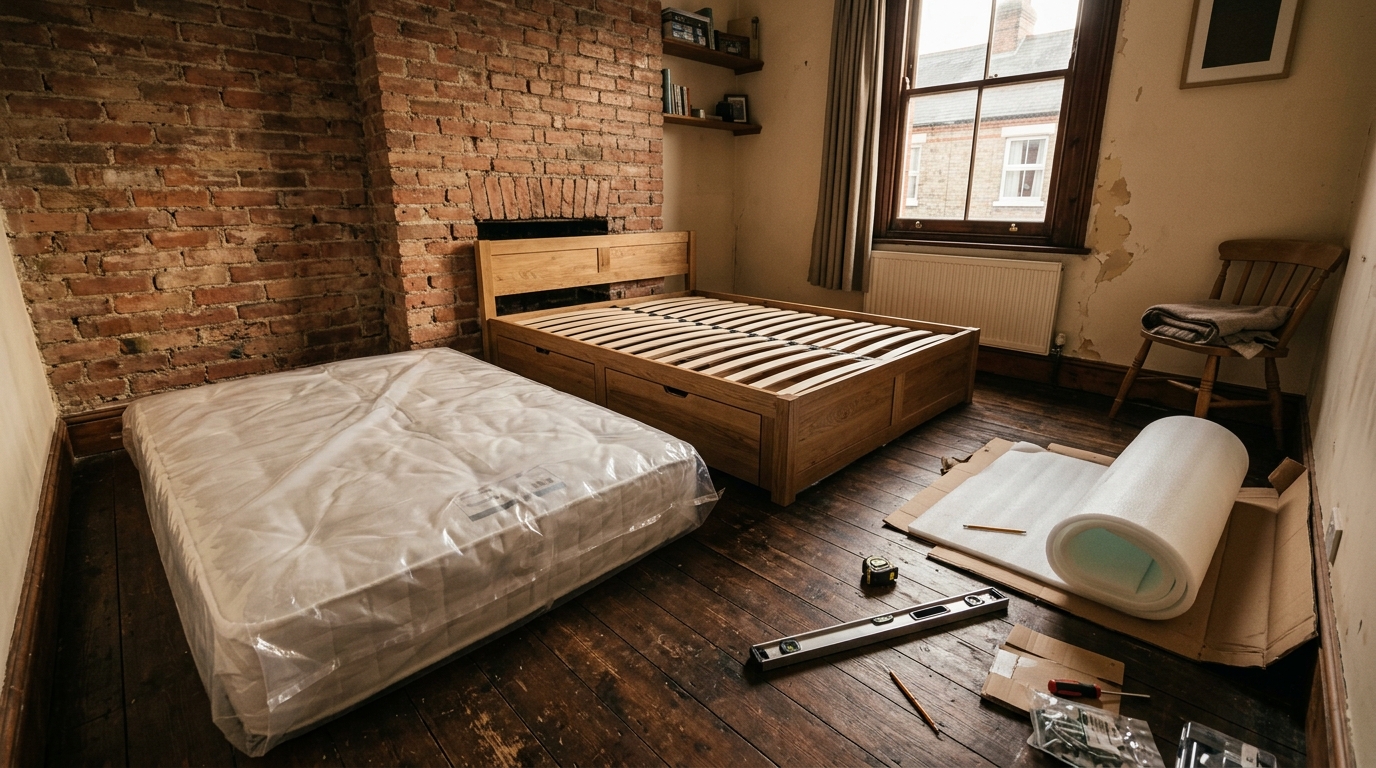
Moving a modern mattress into a Victorian terraced house usually ends with scratched plaster, a trapped king-size bed, and a lot of swearing on the landing. Period homes have narrow staircases with sharp overhangs and box rooms that trap damp like a sponge. If you want to avoid wedging your new bed in a doorframe or throwing it out six months later because it smells of mildew, you need to measure the stairs and pick materials that actually breathe.
What Size Mattress Fits in a Victorian Box Room?
A standard UK Double (135 × 190 cm) is the largest mattress you can safely fit up most Victorian terraced staircases and into a typical box room. While a King (150 × 200 cm) might technically fit on the floor plan, the 70 cm width of a period staircase and the tight landing turn makes getting it upstairs nearly impossible without bending the springs.
Victorian box rooms are notorious for looking larger on the floor plan than they feel once you step inside. A larger bed often leaves no room for bedside tables, let alone a proper airflow gap against the walls.
The Staircase Test – a quick visual checklist you can run with a tape measure:
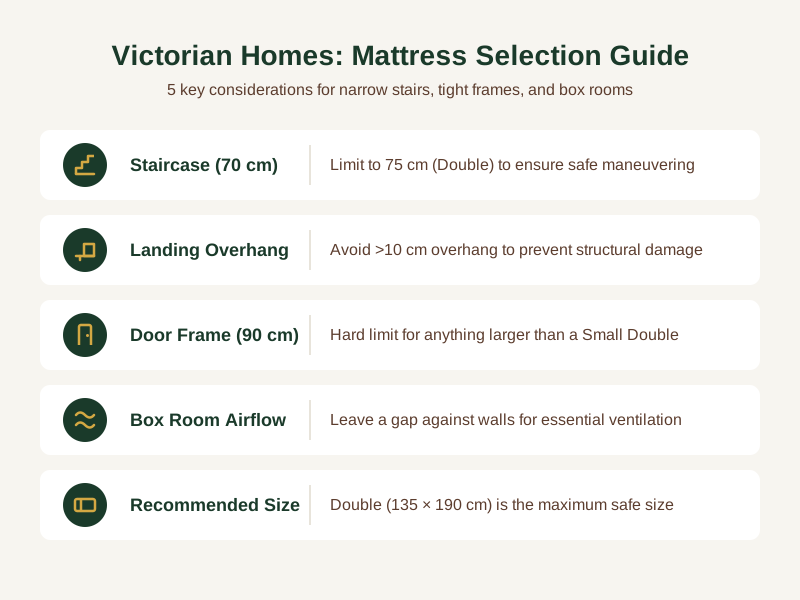
- Measure the clear width between the banister posts – most period staircases sit around 70 cm, but you’ll need at least 75 cm to manoeuvre a double-sized mattress.
- Check the vertical “nose” on the landing turn – the overhang can chew up a mattress’s bottom edge if it’s more than 10 cm high.
- Test the door frame – can you tilt the mattress sideways to slip through? A 90 cm wide door is a hard limit for anything larger than a Small Double.
Picture a 180 × 200 cm mattress wedged halfway up a winding stairwell, the banister doing all the heavy lifting. That’s the risk you’re measuring for: in the vast majority of Victorian terraces, a Super King is a fantasy; a Double or Small Double (120 × 190 cm) is the realistic ceiling.
If you’re still unsure, the National Bed Federation size guide breaks down UK dimensions clearly — a Double is 135 × 190 cm, a King is 150 × 200 cm — so you can double-check your room before you order.
Why Damp Is the Enemy of Your New Mattress
Victorian homes love a good story about rising damp, and they also love trapping moisture in the very things that should keep you comfortable. According to Shelter’s guidance on damp in rented homes , poorly insulated period properties are particularly prone to condensation, which creates a perfect breeding ground for mould spores in your bedroom.
Material science matters:
- Avoid standard memory foam – it’s a sponge for humidity and can stay damp for days, leading to that musty smell you’ll hate waking up to.
- Choose natural latex or pocket-sprung constructions. Latex is naturally anti-microbial and allows air to circulate through its cell structure, while pocket springs create channels that let any stray moisture evaporate.
The cover is the unsung hero. Look for moisture-wicking fabrics such as bamboo viscose or Tencel; they pull sweat away from the body and, importantly, don’t hold it like cheap polyester does.
A cheap foam topper in a damp attic conversion is a sponge. It will hold moisture, pick up a musty smell, and often has to be thrown out within a season. A breathable mattress is cheaper than repeating that mistake.
Damp-Proofing Checklist (before you even think about buying):
- Run a dehumidifier for a week and note the humidity reading – aim for below 60% in the bedroom.
- Leave the bedroom door ajar for a few hours each day to let fresh air circulate.
- Place a thin waterproof mat under the bed frame to stop any rising damp from seeping up through the floorboards.
For a deeper dive, look for mattresses with natural latex or pocket-sprung constructions paired with moisture-wicking covers like bamboo viscose or Tencel – they breathe far better than standard memory foam in damp rooms.
The “Banister” Test: How to Get It Up the Stairs
Getting a mattress up a Victorian staircase is half logistics, half physics. Here’s the step-by-step that saves backs and banisters from a full-on demolition.
- Gather two strong mates – you’ll need a firm grip on each end; one person alone is a recipe for a broken back.
- Lay a moving blanket on the banister and the landing – this protects the wood from scratches and gives you a bit of slip.
- Tilt the mattress to a 45-degree angle – the narrowest profile lets you slide the top edge past the door frame first.
- Pivot at the landing “nose” – this is the tricky part. Hold the top of the mattress up while the bottom slides onto the landing, then gently lower the top.
- Use a short piece of rope to guide the mattress down the final few steps if the landing is particularly narrow; a little belt and braces approach never hurts.
This way you’ll avoid the most common cause of damage – the landing overhang. The Health and Safety Executive (HSE) manual handling guidelines stress measuring the vertical clearance before you even lift; skipping this step does the banister a disservice and could land you a fine if you are renting.
If you’re feeling a bit nervous, the HSE manual handling guidance covers the key principles, and your removal firm should be able to advise on particularly tricky stairwells.
What to Look For in a Mattress for a Victorian Terrace
Victorian terraces come with a specific set of problems: cold external walls, poor ventilation, and narrow staircases. The mattress you choose needs to handle all three. Here’s what actually matters.
Breathability first. Damp is the number one enemy in a Victorian bedroom. Avoid solid memory foam — it traps moisture and, in a poorly ventilated room, creates the conditions for mould. Natural latex and pocket-sprung mattresses let air move through the layers, keeping the surface dry and fresh. Look for covers in bamboo, Tencel, or wool rather than polyester.
Natural latex is the premium choice for damp-prone rooms. It’s naturally anti-microbial, stays cool in summer and doesn’t hold moisture. The firmer feel suits back and stomach sleepers well. Expect to pay £600–£900 for a decent double from UK specialists.
Pocket-sprung with breathable foam layers is the better value option. Each spring sits in its own fabric sleeve, so air circulates freely. Choose a model where the foam comfort layer is described as “open-cell” or “breathable” — solid foam comfort layers defeat the purpose. Budget £300–£500 for a reliable UK double.
Divan base with storage works well in box rooms where under-bed space is the only storage available. Pair it with a natural latex or open-cell foam topper (8–10 cm is enough) to get the breathability benefit without buying a full latex mattress.
Staircase clearance. Before you order anything, measure the width of your narrowest landing or turn. A rolled mattress (bed-in-a-box style) is almost always easier to get upstairs than a traditionally packaged one in a Victorian property.
Whatever you choose: avoid memory foam, prioritise breathable covers, and check the return policy — Victorian rooms vary enough that what works in one flat may feel wrong in another.
Common Questions
Can I put a memory foam mattress in a Victorian box room?
Avoid standard memory foam in a Victorian terraced house. It traps heat and moisture, which in a poorly ventilated attic or back-to-back bedroom creates a perfect recipe for mould. Natural latex or pocket-sprung options breathe far better and keep the mattress fresh.
What is the best mattress size for a Victorian terrace bedroom?
A UK Double (135 × 190 cm) is usually the maximum safe size for a period home. Most Victorian staircases simply cannot handle the width of a Super King, and a Double still leaves enough room in a box room for bedside tables and a bit of airflow against the walls.
How do I stop my mattress from getting damp?
Run a dehumidifier to keep your bedroom humidity below 60% and leave the door open for a few hours each day to let air circulate. Choose a mattress with a breathable cover, like bamboo or Tencel, and never push the bed directly against a cold external wall.
Victorian Staircase & Room Dimensions
| Feature | Typical Victorian Size | Safe Limit for Mattress |
|---|---|---|
| Staircase Width | 70 cm | 75 cm (Double) |
| Landing Overhang | Up to 10 cm | Avoid >10 cm to prevent damage |
| Door Frame Width | 90 cm | Hard limit for anything > Small Double |
| Box Room Airflow | Tight | Leave gap against walls for ventilation |
| Recommended Mattress Size | Double (135 × 190 cm) | Maximum safe size for most homes |
Ready to Start?
You’ve got the two big hurdles sorted: the right size for those narrow stairs and a material that won’t turn your bedroom into a mouldy nightmare. The next step is to line up a mattress that ticks both boxes, measure your landing one more time, and recruit a mate for the lift-and-tilt.
You now have the full picture – Get the Free Sleep Better Checklist to make sure you haven’t missed any hidden damp-proofing or moving steps.
Sleep is cheap, but a bad night’s rest in a Victorian terrace can cost you in health, mood, and even your landlord’s patience. Pick a breathable, appropriately sized mattress, get it up the stairs without a banister-break incident, and you’ll be back to dreaming of proper rest in no time.
Good luck, and if you hit a snag, give us a shout via the contact page – we’re always up for a chat about stubborn stairs or stubborn mould.
Related Guides
For a complete overview, see our Best Mattress for Side Sleepers UK .
References
Note: For specific advice, always consult a qualified professional — content here is for general guidance only.